
What Is Model-Based Definition? MBD Explained for Manufacturing
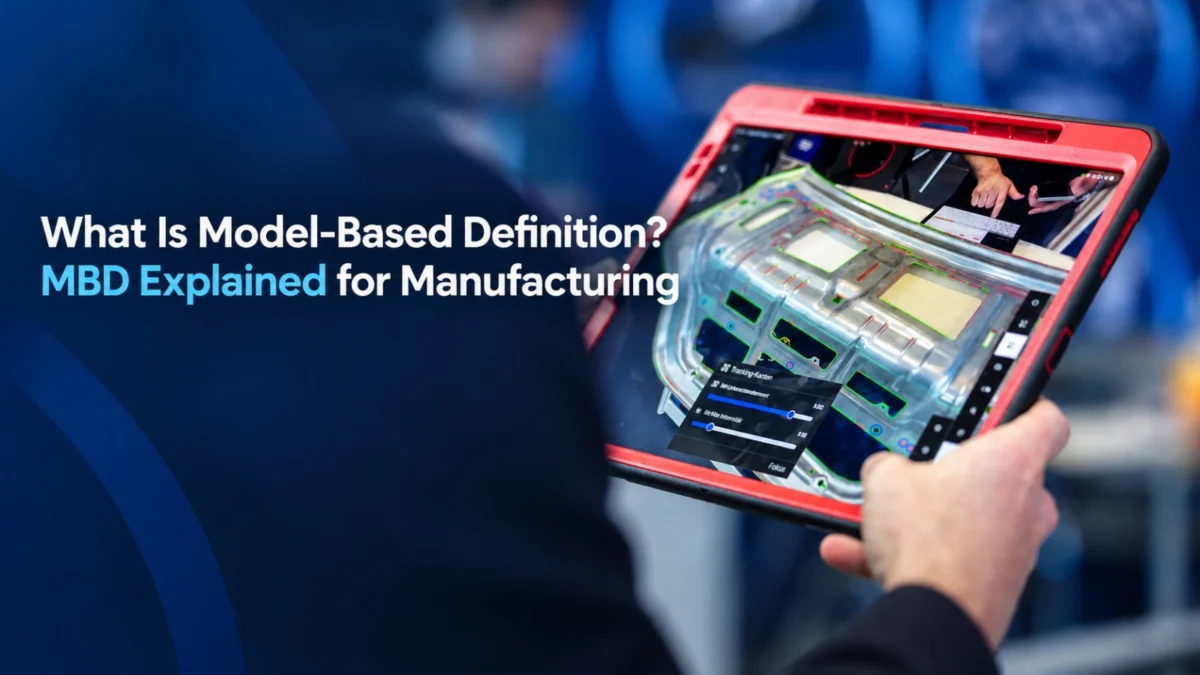
Model-based definition (MBD) is an approach in which the 3D CAD model carries the product definition, including dimensions, tolerances, and annotations, instead of relying on a separate 2D drawing. The annotations that describe how a part should be made are called product manufacturing information (PMI). MBD can provide production and quality teams with a structured digital product reference that brings geometry and associated product-definition information together in the 3D model. SuPAR can use available CAD geometry as the digital reference for AR-guided visual verification. Inspection checkpoints and annotations are prepared in SuPAR Composer, while dimensional measurement and tolerance evaluation remain outside the scope of SuPAR.
What is model-based definition (MBD)?
Model-based definition is a method of defining a product directly in its 3D model. Instead of creating a 2D drawing as the primary record, the designer attaches the manufacturing information to the model itself. This information can include geometry, datum references, dimensions, and notes. Industry standards, such as ISO 16792:2021, Technical product documentation: Digital product definition data practices, describe how this information should be structured and exchanged. MBD is used to reduce the number of separate documents that must be kept consistent across design, production, and quality.
What is product manufacturing information (PMI)?
Product manufacturing information is the non-geometric data that accompanies a 3D model. It includes dimensions, geometric tolerances, surface finish, notes, material specifications, and other instructions that tell manufacturing and quality teams how a part should be produced and checked. In an MBD workflow, PMI is associated with the 3D product definition, although how much of that information is preserved and exchanged depends on the CAD system and file format used. Some PMI is used for machining or inspection planning, while other parts of it are used as visual references on the shop floor.
How does model-based definition differ from 2D drawings?
A 2D drawing presents the product through views, sections, and annotations on a sheet. The reader must interpret the drawing and mentally translate it into the three-dimensional part. In MBD, the annotations are linked to the model, so the same definition can be viewed in 3D. This reduces the need for mental translation, although it does not remove the need for clear standards and disciplined data management. The two approaches can coexist during a transition period, and many organisations keep drawings for legacy parts while adopting MBD for new programmes.
Which industries use model-based definition?
Model-based definition is used in aerospace, defence, automotive, heavy machinery, and other sectors that manage complex products with large numbers of parts and suppliers. These industries often require strict traceability and consistent definitions across design and production. Adoption depends on the maturity of the CAD tools, the data exchange practices between partners, and the readiness of the shop floor to use digital references.
How is model-based definition used in quality inspection?
In quality inspection, an MBD dataset can provide engineering reference information for understanding the intended product definition, while the inspection method used depends on what needs to be verified. Inspectors and quality engineers can use the model to plan checks, identify features that must be verified, and confirm that the assembled or machined part matches the expected configuration. For AR-guided visual verification, CAD geometry can be used as a digital reference to support presence, expected-position, and absence checks for defined features. Where dimensional or tolerance checks are required, those are carried out with dedicated measurement equipment, which is outside the scope of SuPAR.
How can PMI be visualized on the physical part with AR?
Augmented reality can display CAD-based reference information and inspection guidance in the context of the physical part, helping operators understand where defined inspection checkpoints apply. Using SuPAR App, inspection checkpoints and visual guidance can be prepared from CAD data in SuPAR Composer and then delivered so operators can visually verify defined features in context on the shop floor. The usefulness of this approach depends on the quality and structure of the CAD data, and on how the checkpoints are defined in SuPAR Composer. AR visualization supports interpretation of the reference and does not generate dimensional results.
What should you consider before adopting an MBD workflow?
Adopting MBD involves more than changing the file format. Organisations should review their CAD systems and how they store and exchange PMI, confirm that suppliers can work with the same data, and define which standards govern the process. Teams also need to decide which data will be used on the shop floor, who maintains the model, and how changes are controlled. A pilot project on a single product line is often a practical way to test the workflow before it is extended across the organisation.
Frequently Asked Questions
Is model-based definition the same as model-based enterprise?
- Model-based definition refers to the use of 3D models to carry the product definition. Model-based enterprise is a broader concept that describes an organisation using model-based data across design, manufacturing, quality, and service. MBD is one component of a model-based enterprise.
Which CAD formats can carry PMI data?
The ability to carry PMI depends on the CAD system and the exchange format used. Neutral formats such as STEP AP242 are commonly used to transfer PMI between systems. The exact data that is preserved depends on the source software and export settings, so teams should test the exchange before relying on it in production.
Does model-based definition eliminate 2D drawings completely?
Not always. Many organisations keep 2D drawings for legacy parts, supplier requirements, or specific approval processes. MBD can reduce drawing use significantly, but the transition is usually gradual, and the right balance depends on the company’s processes and partners.
Which standards apply to model-based definition?
Relevant standards include ISO 16792:2021 for digital product definition data practices and ASME Y14.41 for digital product definition in the United States. Some industries add their own requirements through customer specifications. Teams should confirm which standards apply to their programmes before defining the workflow.
Can shop floor teams use MBD data without CAD software?
Shop floor teams can often use MBD data through viewers, exported views, or digital work instructions without running a full CAD system. The available data depends on how the information is prepared and delivered. Tools such as SuPAR App are designed to present CAD references on the shop floor, where the preparation is done in SuPAR Composer.