SuPAR AI – AI-Assisted Visual Inspection
AI-powered automatic visual quality detection
Overview
AI-assisted visual inspection is a quality inspection approach in which deep learning models handle selected repetitive checks while the operator stays responsible for the overall inspection and the final judgement. SuPAR AI applies this approach inside the augmented reality inspection your team already runs on a tablet, automating defined and recurring targets such as spot welds, holes and studs. It runs within the existing SuPAR App workflow rather than as a separate system, and its performance depends on training data, imaging conditions, process variation, and validation.
What does AI-assisted visual inspection mean in practice?
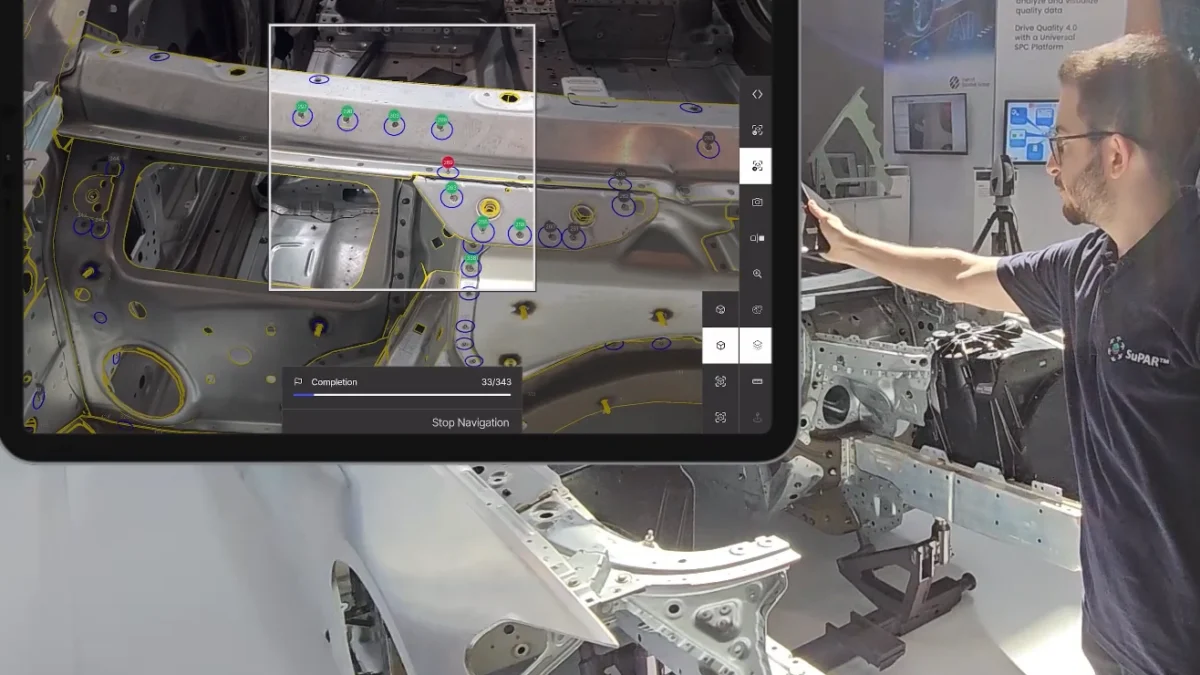
On a high-volume part, a large share of the inspection is repetition: locating and confirming the same feature type again and again across a panel or an assembly. SuPAR AI is scoped to that repetition. Its modules recognise defined target types as the operator works through the AR inspection and flag targets that appear missing, out of position or incomplete.
This is not the same as general defect detection. SuPAR AI works on presence, position and absence verification for target types it has been trained and validated for. Surface condition, dimensional deviation and tolerance verification remain outside its scope, and the operator continues to make the accept or reject decision.
What can SuPAR AI check automatically?
SuPAR AI currently includes specialised modules for:
| Module | What it supports |
|---|---|
| Hole detection | Presence and position verification of holes on panels and assemblies |
| Spot welding verification | Confirmation of spot weld locations against the defined inspection template |
| Stud inspection | Presence and position verification of studs |
| Position identification | Checking whether a defined target sits in its expected position |
| Absence detection | Flagging targets that are expected but not found |
Each module is tied to a defined target type rather than to a general category of defects. Coverage for a specific part depends on how the inspection template is prepared in SuPAR Composer and on whether the relevant target types have been validated for that application.
How does SuPAR AI fit into the inspection workflow?
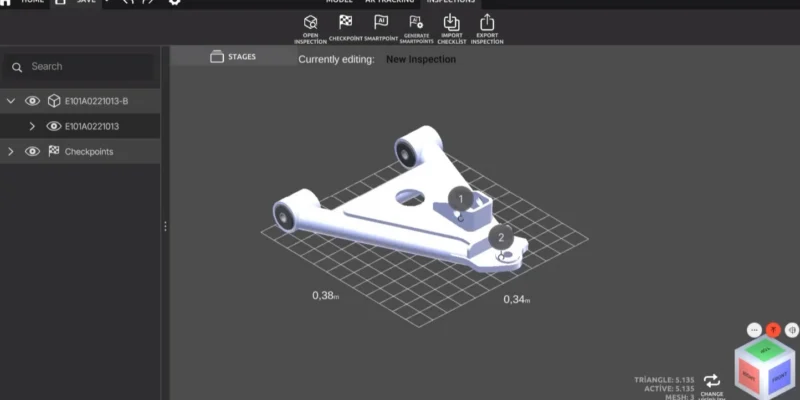
- Define targets in Composer. In SuPAR Composer, the recurring target types are included in the inspection template alongside CAD geometry, checkpoints and visual annotations.
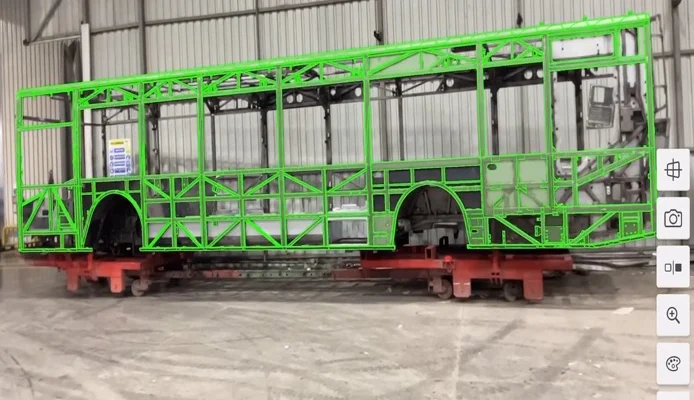
- Run the inspection in the App. On a tablet, SuPAR App runs the AR inspection with nominal CAD geometry overlaid on the physical part, while SuPAR AI checks the defined targets. The operator handles everything that needs judgement.
- Review and share in Web Viewer. Inspection steps and findings are recorded and can be opened by colleagues in SuPAR Web Viewer, directly on the 3D model.
There is no separate AI application to install or operate. The same template, the same device and the same inspection session carry the AI checks, which keeps the shop floor process unchanged for the operator.
How are AI-assisted inspections recorded?
Inspection steps are captured digitally during the inspection rather than transcribed afterwards, which supports a traceable record for later evaluation and review. Results can be produced as structured digital reports, reducing dependence on paper-based methods and making it easier to compare results across parts, shifts and sites.
Because the record is created at the point of inspection, findings stay attached to the target and the position they relate to. This can help quality teams follow up on specific findings without reconstructing the sequence from handwritten notes.
How are new inspection targets added?
SuPAR AI modules are built for defined target types, so extending coverage to a new target is a development activity rather than something the system does on its own. Adding or improving a module involves collecting representative and correctly labelled images from the application, retraining the relevant model, and validating its behaviour under real imaging conditions before it is used in production.
The volume of data, the effort required and the resulting performance vary by application. Part geometry, surface finish, lighting on the shop floor and normal process variation all affect what is achievable, so scope should be confirmed per use case rather than assumed from another deployment.
Where does SuPAR AI add the most value?
SuPAR AI is most relevant where checks are repetitive, well defined and high in volume:
- Body in White, for spot weld and stud verification on automotive assemblies
- High-volume hole and feature checks on large panels and structures
- Incoming and supplier parts with repeated features to confirm
- End-of-line completeness checks across many identical targets
It is used by teams in automotive, aerospace and defence, heavy industry, agricultural and construction machinery, energy, mining, and injection moulding. Suitability depends on the target type and the inspection conditions rather than on the industry alone.
How is SuPAR AI different from machine vision systems?
Fixed-camera automated optical inspection systems are typically installed at a defined station, with controlled lighting and fixed part positioning, and are designed to run without an operator. SuPAR AI works inside a handheld AR inspection on a tablet and supports the operator rather than removing them from the process.
The two approaches suit different situations. Where parts are large, mixed or moved through several stations, and where a dedicated vision cell would be difficult to justify, an AR-based workflow with AI support for repetitive targets can be a more practical fit. Where a single high-volume feature is checked at a fixed station under controlled conditions, a dedicated vision system may remain the better answer.
Frequently asked questions
What is AI-assisted visual inspection?
It is visual quality inspection in which AI handles selected repetitive checks, such as recognising and confirming recurring features, while the operator stays in control of the overall inspection and any judgement calls. It is a hybrid approach rather than a replacement for human inspection.
What can SuPAR AI verify automatically?
SuPAR AI includes modules for hole detection, spot welding verification, stud inspection, position identification and absence detection. These cover presence, position and absence verification for defined target types. Coverage for a given part depends on the inspection template and on validation for that application.
Does SuPAR AI replace the inspector?
No. SuPAR AI works inside the SuPAR App workflow and supports the operator by taking on repetitive checks, so attention can go to decisions that need a human eye. The operator remains responsible for the inspection and the accept or reject decision.
How is SuPAR AI different from machine vision or AOI systems?
SuPAR AI runs inside an AR inspection on a tablet and supports the operator, rather than acting as a fixed camera system at a dedicated station. It fits an existing shop floor process instead of requiring dedicated vision hardware and controlled part positioning.
How accurate is SuPAR AI?
Performance depends on training data, imaging conditions, process variation and validation, so a single accuracy figure would not be meaningful across applications. Expected behaviour for a specific target type and part should be established through validation during evaluation.
Capabilities
- Deep learning-based visual inspection
- Automatic position identification and absence detection
- Hole detection and verification module
- Spot welding quality assessment module
- Stud presence and installation verification
- Plug-and-play inspection model architecture
- Effortless verification with instant capture
- Comprehensive automated reporting
- Scalable for high-volume production