
Remote Visual Inspection: How Manufacturing Teams Collaborate Digitally
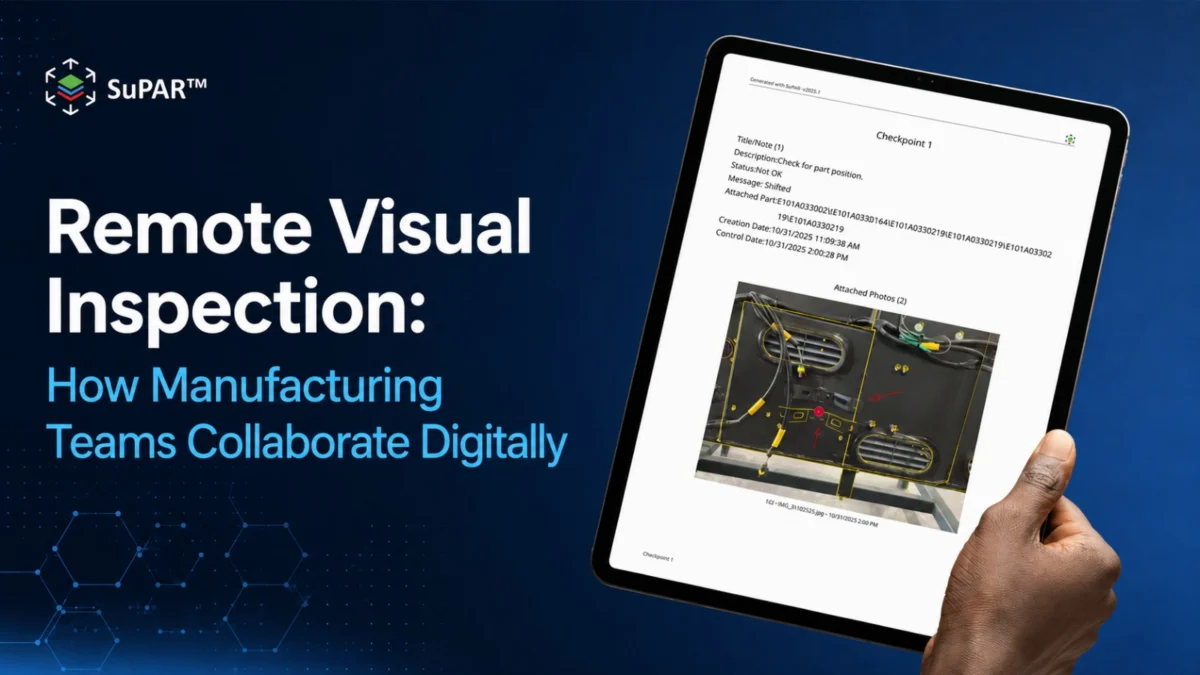
Remote visual inspection is a quality inspection approach in which a product, component, or assembly is examined visually by one or more people who are not physically present at the inspection location. Remote visual inspection uses digital tools, cameras, and communication systems to share inspection views, findings, and records between people in different locations.
In manufacturing, remote visual inspection is increasingly relevant for distributed production operations, multi-site quality teams, supplier quality management, and situations where bringing a qualified inspector to a specific location is impractical or time-consuming. The availability of digital inspection tools and augmented reality platforms has expanded what is possible in remote quality collaboration.
What is remote visual inspection?
Remote visual inspection means that the person evaluating the inspection results, making accept/reject decisions, or providing guidance is not standing next to the physical part. Inspection may be performed by an operator on-site while a quality engineer, customer representative, or specialist reviews the results remotely, either during the inspection or afterwards.
Remote visual inspection differs from remote visual examination of inaccessible areas, such as using borescopes to inspect inside pipes or vessels. In manufacturing quality contexts, remote visual inspection most often refers to digital collaboration around inspection activities on the shop floor, using shared screens, cameras, or AR inspection platforms.
The value of remote visual inspection in manufacturing is primarily organizational: it allows qualified people to contribute to inspection decisions without being physically present, and it creates a shared digital record that can be reviewed, approved, or escalated by anyone with access.
What technologies and tools support remote visual inspection?
Remote visual inspection in manufacturing relies on a combination of hardware and software tools:
Cameras and live streaming: Camera systems mounted at inspection stations or carried by operators can stream live video to remote reviewers. This enables observation of the inspection process and verbal guidance from a remote specialist.
AR inspection platforms: Augmented reality platforms like SuPAR App allow operators on the shop floor to perform structured, CAD-guided inspection while capturing digital records that can be shared with remote reviewers. The inspection template is prepared in SuPAR Composer from existing CAD data, so remote reviewers can see the inspection structure, the reference geometry, and the captured results without needing to be on-site.
Digital inspection records: Tools that capture inspection findings and results, photographs, annotations, and pass/fail decisions digitally during the inspection process create a record that remote stakeholders can review afterwards. This is often more practical than reviewing during the inspection itself, particularly across time zones or for routine inspection activities.
Quality management systems: Where a quality management system is already in use, inspection records can form part of broader quality workflows. Any required connections with existing production or quality systems should be evaluated according to the specific implementation environment.
How does remote visual inspection differ from on-site inspection?
Remote and on-site visual inspection share the same goal, verifying that a product meets defined requirements, but they differ in how inspection is conducted and what information is available to the person making quality decisions.
| Dimension | On-Site Inspection | Remote Visual Inspection |
| Physical access | Direct, unrestricted | Limited to camera view or operator observation |
| Interaction during inspection | Immediate | Depends on connection and setup |
| Tactile assessment | Available | Not available |
| Record quality | Depends on documentation | Digital, structured, searchable |
| Travel and logistics | Required for remote sites | Reduced for inspection activities that can be reviewed remotely |
| Scalability | Limited by personnel availability | Broader reach with the same team |
On-site inspection allows direct physical access to the part, including tactile assessment and unrestricted viewing angles. Remote inspection is constrained by what the camera shows and what the on-site operator can communicate. For this reason, remote visual inspection works best when the inspection process is structured in advance, with defined checkpoints and clear documentation requirements, rather than relying on ad-hoc communication during the review.
How does remote visual inspection work in a manufacturing environment?
In a manufacturing environment, remote visual inspection typically works through a structured process:
Inspection preparation: The inspection template is prepared from CAD data, defining the checkpoints, reference geometry, and acceptance criteria for each inspection step. SuPAR Composer supports this preparation, creating reusable inspection templates that operators can follow on the shop floor.
On-site execution: The operator on the shop floor follows the structured inspection sequence using an AR-capable device. CAD geometry and inspection guidance are overlaid directly onto the physical part. The operator captures pass/fail results, photographs, and annotations at each checkpoint.
Remote review: The captured inspection record can be shared with remote reviewers through available digital review tools. Quality engineers, customer representatives, or specialists can review inspection results, photographs, and annotations without needing to be physically present during the inspection.
Escalation and decisions: If a nonconformance is identified, the digital inspection record can support remote review and communication between relevant quality stakeholders. Traceable records can also support documentation and audit preparation.
What are the benefits of remote visual inspection for quality teams?
Remote visual inspection offers several practical benefits for manufacturing quality operations:
Reduced travel and response time: Quality engineers and specialists can review inspection results, support disposition decisions, and monitor quality trends without traveling to the production site. This is particularly valuable for manufacturers with multiple facilities, remote supplier operations, or global customer relationships.
Consistent inspection execution: Structured, AR-guided inspection workflows can help on-site operators follow a consistent inspection procedure regardless of which specialist is available to review. The inspection template provides defined checkpoints and guidance, while remote review supports evaluation of the captured inspection results.
Scalability: Remote visual inspection allows a central quality team to support multiple sites or production lines, rather than dedicating one specialist to each location.
Improved documentation: Digital inspection records created during structured remote inspection can provide more consistent, searchable documentation than handwritten notes or informal photograph collections, and can support audit preparation.
Customer and audit support: Remote access to inspection records allows customers and auditors to review quality evidence without requiring physical presence at the production facility.
What are the challenges of remote visual inspection and how can they be addressed?
Remote visual inspection introduces challenges that on-site inspection does not face:
Limited physical access: Remote inspectors cannot handle the part, assess surface feel, or view angles not captured by the camera. This can be partially addressed by ensuring that inspection templates are designed to capture the specific views and features that remote reviewers need to assess.
Dependence on camera quality and positioning: The value of remote visual inspection depends on the quality and positioning of the camera view. Poor lighting, low resolution, or suboptimal camera angles can make remote assessment unreliable. Controlled lighting and structured camera positioning at inspection stations improve remote inspection reliability.
Communication delays: Reviewing during the inspection itself, across time zones or with poor connectivity, can introduce delays that slow inspection throughput. Workflows where structured records are reviewed after the inspection is complete can address this.
Training and process adoption: On-site operators need to be trained on the inspection platform and the structured process. Consistent execution on the operator side is a prerequisite for reliable remote review.
How do you implement remote visual inspection on your shop floor?
Implementing remote visual inspection in a manufacturing environment involves several steps:
Define the inspection scope: Identify which inspection activities are suitable for remote review. Highly structured inspections with defined checkpoints and clear visual evidence requirements are the best fit. Inspections that require tactile assessment or complex judgment from direct physical access may not be suitable for fully remote review.
Prepare structured inspection templates: Using existing CAD data, prepare inspection templates that define the checkpoints, reference geometry, and documentation requirements for each inspection step. SuPAR Composer supports this preparation process.
Equip on-site operators: Provide operators with AR-capable devices and train them on the structured inspection workflow. Consistent execution by on-site operators is the foundation of reliable remote review.
Establish remote access: Ensure that remote reviewers can view inspection records, photographs, and annotations through the digital review tools available in your environment.
Define review and escalation processes: Establish clear processes for how remote reviewers handle inspection results, including who makes disposition decisions for nonconformances and how escalations are managed.
Frequently Asked Questions
Can remote visual inspection meet the same quality standards as on-site inspection?
Remote visual inspection can support the same defined inspection procedures for suitable visual inspection activities when the required evidence can be captured and reviewed digitally. Its suitability depends on the inspection type: structured checklist-based visual inspection with digital records is well suited to remote review. Inspections requiring tactile assessment or complex physical access are less suited. The structured inspection workflow and quality of the digital record are the key factors.
What hardware is needed for remote visual inspection?
At a minimum, remote visual inspection requires a camera-capable device on the inspection side and a way for the remote reviewer to access the resulting record. AR inspection platforms such as SuPAR App run on standard tablet hardware, typically iPad Pro. For live remote observation, a reliable network connection is required. For review of structured inspection records after the fact, lower connectivity requirements apply.
How does AR remote visual inspection work?
In AR-guided remote visual inspection, the on-site operator uses an AR device to follow a structured inspection template, with CAD geometry and checkpoints overlaid directly onto the physical part. The operator captures pass/fail results, photographs, and annotations at each step. The completed inspection record can then be shared with remote reviewers, providing a structured, documented account of the inspection without requiring the reviewer to be present.
Is remote visual inspection suitable for high-mix, low-volume manufacturing?
Remote visual inspection can work in high-mix, low-volume environments if inspection templates are prepared in advance for each product variant. CAD-driven template preparation, as supported by SuPAR Composer, makes it practical to create and reuse structured inspection templates for different products and product variants. The structured template approach reduces reliance on individual operator judgment and supports consistent documentation across product variants.
How do you document findings from remote visual inspection?
Remote visual inspection documentation can be generated during the structured inspection process, with checkpoint results, photographs, and annotations captured in a digital inspection record that can be reviewed and shared remotely. This creates a searchable record that can be used for customer documentation or audit preparation. The quality of documentation depends on the completeness of the inspection template and the consistency of operator execution.