
Meisterbock and Cubing Verification with Augmented Reality
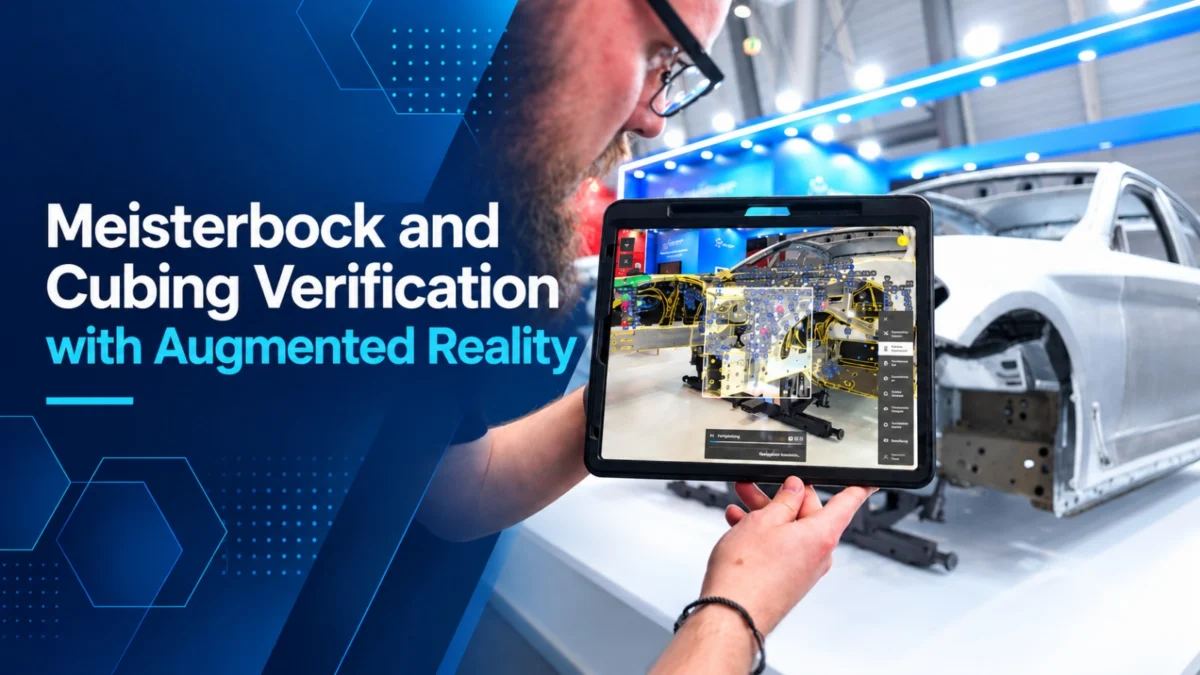
Meisterbock and cubing verification with augmented reality is the use of AR overlay to confirm that a master body structure and its adapters are built and configured according to their design data, by placing nominal CAD geometry onto the physical structure itself. The check covers interface plates, adapters, locators, and variant hardware rather than the fit of the parts mounted on them.
A Meisterbock and a cubing model are among the most carefully controlled physical objects in a vehicle programme. They exist precisely because a stable physical nominal is needed. That does not make them immune to configuration error, because both are reconfigured repeatedly across a programme, and a master structure in the wrong configuration produces confident conclusions that happen to be wrong.
What is a Meisterbock?
A Meisterbock is a rigid, dimensionally stable master structure that represents the nominal geometry of a vehicle body. It carries the interfaces where attachment parts belong, so that doors, hoods, fenders, lamps, bumpers, and trim components can be mounted against nominal conditions rather than against another physical part that carries its own deviations.
The German term translates roughly as master buck, and it is used in English language automotive engineering without translation, which is common for tooling terminology that originated in German vehicle development practice.
Its purpose is arbitration. When a supplier part does not fit on a vehicle, the disagreement is usually about whether the part is wrong or the surrounding structure is wrong. Mounting the part on a master structure removes one variable from that question. This is why a Meisterbock tends to be treated as a controlled reference asset with its own verification and access rules.
What is cubing in automotive manufacturing?
Cubing refers to a full scale physical model of a vehicle’s nominal surfaces, produced to high accuracy from dimensionally stable material. Where a Meisterbock represents the structural side and the attachment interfaces, a cubing model represents the outer skin and, in some programmes, interior surfaces.
Its main use is the evaluation of gap and flush conditions. A trim part, lamp, or panel is presented against the cubing surface and the resulting gap is assessed against what the design intends, both visually and with gauges.
Terminology varies between manufacturers. Some organisations use cubing, some use master model or data control model, and some treat Meisterbock and cubing as a single combined installation. In practice the two are frequently operated together, with the structure and the surface model forming one reference environment for a programme.
How do Meisterbock and cubing differ?
| Meisterbock | Cubing model | |
|---|---|---|
| Represents | Nominal body structure and interfaces | Nominal exterior and interior surfaces |
| Primary use | Mounting and fit of attachment parts | Gap and flush evaluation |
| Typical question | Does this part mount correctly at nominal | Does this part sit correctly against nominal surface |
| Built from | Structural frame with adapters and interfaces | Machined stable material replicating surfaces |
| Reconfigured | Frequently, per variant and per part family | Less frequently, per surface revision |
The distinction matters for verification because the two carry different risk profiles. A cubing model is a machined surface that changes when a revision is cut. A Meisterbock is an assembly of adapters and interface hardware that changes whenever a different variant or part family is set up, which makes configuration error the more frequent concern.
What is checked on a Meisterbock?
Activity at a master structure separates into two layers, and they are easy to conflate.
The first layer concerns the parts being evaluated. Does the door mount correctly, is the gap within intent, is the flush condition acceptable. This is judgement work, supported by gauges and by measurement where a numeric result is required, carried out by people with programme experience.
The second layer concerns the master structure itself. Are all adapters fitted, is the correct variant configuration set up, is an interface plate installed in the intended position, is a locator missing after the last changeover. These are presence, position, and absence questions against released design data, they recur every time the structure is reconfigured, and they are answered by visual comparison rather than by measurement.
Augmented reality applies to the second layer. It can support confidence that the reference environment is in its intended state before the first layer of work begins.
How can AR support Meisterbock verification?
Preparation happens away from the structure. The released master structure CAD is imported into SuPAR Composer, where the responsible team defines inspection checkpoints for adapters, interface plates, locators, and variant hardware, and adds visual annotations at points where configurations are easy to confuse. The result is a reusable inspection template prepared for a specific structure configuration.
At the structure, the template is opened in SuPAR App. Nominal geometry is overlaid onto the physical assembly and the operator works through checkpoints in sequence, which makes it easier to identify missing, extra, or misaligned elements without interpreting layout drawings alongside a large installation.
Two aspects fit this environment well. Master structures are physically large, so maintaining the CAD reference in the context of the physical structure can reduce the need to repeatedly move between the installation and separate drawings or screens. And configurations repeat across a programme, so the same structured checkpoint sequence can be applied at each changeover, reducing dependence on individual recall.
What should a Meisterbock check record include?
A configuration check record for a master structure tends to cover:
- Reference context. Clearly identify the CAD configuration or design revision used as the basis for the verification.
- Variant configuration. Which programme variant and part family the structure is set up for, stated explicitly rather than assumed.
- Adapter and interface checkpoints. Named elements with expected positions, not a general instruction to check the setup.
- Parts mounted at the time. What was present on the structure when the evaluation took place.
- Programme phase. Which development or pre-series stage the record belongs to.
- Evidence captured during the check. Results and photographs recorded at the checkpoint.
- Responsible reviewer. Define who is responsible for confirming the configuration according to the organisation’s existing quality process.
Results can be exported in formats such as PDF, Excel, Word, and 3D, which matters because master structure findings are frequently shared with suppliers during fit discussions and a structured record is easier to send than a marked up layout.
What can AR not replace on a Meisterbock?
This boundary needs to be explicit, because the surface similarity between a digital nominal and a physical nominal invites a conclusion that does not hold.
Augmented reality does not replace a Meisterbock or a cubing model. Those exist to provide a physically stable nominal that a real part can be mounted on, pressed against, and assessed by hand and eye under production lighting. An overlay cannot supply that tactile reference, and it cannot resolve a supplier disagreement about fit in the way a physical master can.
AR also does not measure. It does not produce gap and flush values, evaluate tolerances, assess class A surface quality, or certify the accuracy of the cubing model itself. Certification of a master structure remains measurement work with appropriate equipment on a defined interval.
What AR contributes is narrower and worth stating on its own terms. It can help confirm that the reference environment is configured as designed before the evaluation work that depends on it starts.
Frequently asked questions
Is a Meisterbock the same as a master buck?
The terms are generally used for the same concept, a rigid master structure representing nominal body geometry. Master buck is the more common English rendering, while Meisterbock is used directly in many engineering organisations. Exact definitions vary between manufacturers, so it is worth confirming local usage.
Why is the German term Meisterbock used in English?
Much of the terminology around body construction masters developed in German automotive engineering and travelled internationally with the practice. The original word stayed in use, similar to other tooling terms adopted without translation. It appears in English documentation and supplier correspondence unchanged.
How long is a Meisterbock used in a vehicle program?
Use typically spans development and pre-series, and often continues into series production for fit investigations and supplier issue resolution. The duration depends on programme structure and on how long the organisation needs an arbitration reference for attachment parts.
Can cubing be replaced by digital methods?
Digital methods have reduced dependence on physical models in some areas, but a physical nominal still serves purposes a digital model does not, including tactile assessment and shared physical arbitration with suppliers. The realistic position is complementary use rather than replacement.
Which departments use Meisterbock results?
Findings are commonly used by body engineering, quality, and supplier quality functions, and are shared with suppliers during fit discussions. Because the results influence decisions across several organisations, a structured and traceable record carries more weight than informal notes.
Meta title: Meisterbock and Cubing Verification with Augmented Reality Meta description: What a Meisterbock and cubing model are, how they differ, and how AR overlay supports configuration checks on master body structures. Slug: meisterbock-cubing-verification-augmented-reality Focus keyword: meisterbock Secondary keywords: meisterbock automotive, cubing automotive, meisterbock verification, augmented reality automotive inspection, AR master buck inspection Format tag: definition