
AI for Quality Control in Manufacturing: How It Works
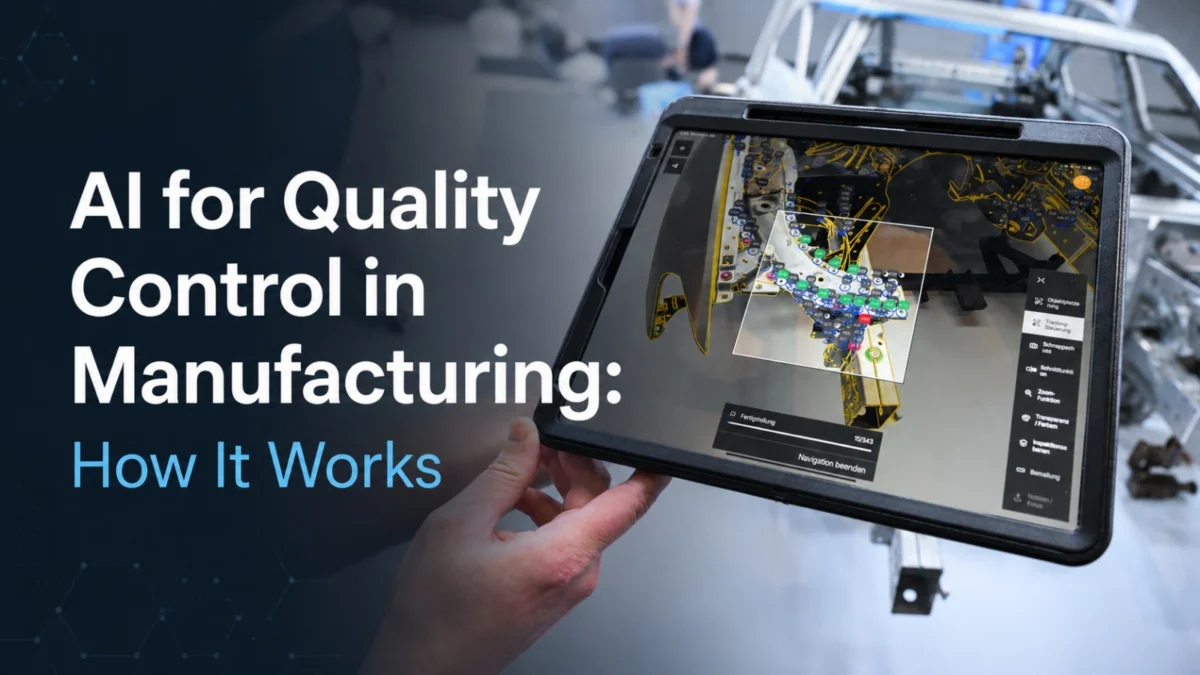
AI for quality control in manufacturing refers to the use of machine learning and computer vision systems to automate selected visual inspection tasks on the production floor. Where traditional inspection depends on operator judgment and paper-based checklists, AI-powered quality control can apply consistent evaluation criteria to repetitive inspection targets, supporting higher inspection volumes without proportional increases in labor.
AI quality control is not a replacement for structured manufacturing inspection. It is a targeted capability that works best when paired with a broader inspection framework, including augmented reality guidance, CAD-based inspection templates, and human oversight for complex or variable inspection tasks.
What is AI quality control in manufacturing?
AI quality control in manufacturing uses trained machine learning models to evaluate defined visual inspection targets, verify the presence or absence of features, and identify visible nonconformances in manufactured parts. The models learn from labeled image data and apply those learned patterns to new inspection images.
AI quality control software for manufacturing is typically built on computer vision and deep learning architectures. These systems use captured images of parts or assemblies, analyze them against trained visual models, and generate inspection results for defined targets.
Unlike traditional rule-based machine vision, AI-powered quality control does not require engineers to explicitly program what each condition looks like. The model learns from training examples, which makes it better suited to variable or complex conditions that resist explicit rule definition.
The scope of what can be verified depends on the training data, imaging conditions, and system configuration. AI quality control works most reliably when applied to well-defined, repetitive inspection targets in controlled production environments.
How does deep learning support AI quality control in manufacturing?
Deep learning models used in manufacturing visual inspection can learn patterns from labeled images of conforming and nonconforming parts. The model learns visual characteristics associated with defined inspection targets and quality conditions.
The training process requires a dataset of part images with accurate labels: which images show conforming parts and which show specific nonconforming conditions, where those conditions appear, and what they look like under production imaging conditions. The quality of the training data directly affects system performance.
Once trained, the model evaluates new images by comparing them against the learned patterns and generates an inspection result for the defined target.
Deep learning models can become less effective when production conditions change significantly from training conditions. Factors such as part variation, lighting changes, and tooling updates may require model retraining or validation to maintain performance.
How does AI quality control compare to traditional rule-based inspection?
Traditional rule-based inspection systems work by evaluating explicit image characteristics at defined locations: edges at a certain threshold, objects within a defined area, or pixel intensities within a calibrated range. These systems work reliably for consistent, geometrically simple inspection targets in controlled environments.
AI quality control differs in how evaluation criteria are established. Rather than programming rules, AI models learn patterns from training data. This makes them better suited to:
- Conditions that are variable in appearance or location
- Surfaces with natural variation that rule-based thresholds misclassify
- Inspection targets where the difference between conforming and nonconforming is subtle or context-dependent
The tradeoff is that AI systems require labeled training data, validation against production conditions, and ongoing maintenance as production changes. Rule-based systems, while less flexible, can be faster to deploy for simple, well-defined inspection tasks.
Most practical manufacturing quality control deployments use both approaches: rule-based logic for straightforward checks and AI-powered verification for more complex or variable inspection targets.
What inspection targets can AI quality control verify: holes, spot welds, and studs?
AI quality control in manufacturing performs best when applied to specific, repeatable inspection targets. Attempting to use a single model for all possible conditions in a production environment typically produces unreliable results.
SuPAR AI applies this targeted approach with dedicated deep learning modules for defined manufacturing inspection tasks:
- Hole verification: Verifying whether expected holes are present and visually located in the expected areas
- Spot weld verification: Verifying the presence and expected placement of defined spot weld points
- Stud inspection: Identifying missing, extra, or visually misaligned studs
- Position verification: Visually verifying whether defined components or features appear in the expected location relative to the CAD reference
- Presence/absence verification: Verifying whether expected components or features are visually present or missing
Performance for each module depends on training data quality, imaging setup, and production process variation. SuPAR App supports operator-guided inspection for the remaining checks that require human judgment or fall outside the defined AI module scope.
What are the benefits of AI-powered quality control in manufacturing?
AI-powered quality control can support manufacturing quality operations in several ways, particularly for suitable repetitive inspection tasks.
Consistent evaluation criteria: AI models apply the same evaluation logic across repeated inspection tasks, helping reduce variability between operators, shifts, or production periods.
High-volume inspection coverage: For suitable applications, AI-powered systems can inspect a larger number of parts per shift than manual inspection allows, without requiring proportional increases in quality labor.
Digital inspection records: Inspection results and captured images can be recorded digitally, creating traceable records that support quality reporting, review, and documentation processes.
Earlier quality feedback in the production process: Applying AI-based inspection at in-process stages can help identify visible nonconformances earlier, before parts move further through the production sequence.
These benefits depend on the application, system configuration, and the degree to which the inspection target is suitable for automated verification. AI quality control does not replace the need for human inspection in cases requiring contextual judgment or for conditions outside the trained scope.
How is AI quality control deployed in manufacturing?
Deploying AI quality control in manufacturing involves several stages: defining the inspection targets, capturing and labeling training data, training and validating the model, integrating the system with the production environment, and establishing ongoing monitoring and maintenance processes.
Key deployment considerations include:
- Imaging setup: Camera positioning, resolution, and lighting configuration must be optimized for the specific inspection target. Changes in lighting or part presentation can affect model performance.
- Training data: The training dataset should represent the range of conforming and nonconforming conditions expected in production, including variation in parts and imaging conditions.
- Validation: Before deployment, system performance should be validated against production samples to confirm reliability and false positive rates.
- Integration requirements: Any required connections with existing production or quality systems should be evaluated according to the specific implementation environment.
- Ongoing maintenance: Production changes, such as new part variants or tooling updates, may require model retraining or revalidation.
How does AI quality control combine with augmented reality inspection?
Combining AI quality control with augmented reality visual inspection allows manufacturers to apply each approach where it delivers the most value. AI supports automated verification of selected, repetitive inspection targets. AR guides operators through the structured inspection checks that still require human presence, judgment, or physical access.
Within the SuPAR suite, this combination works as follows: SuPAR Composer is used to prepare structured inspection projects from CAD data, defining the checkpoints and visual guidance for each inspection step. SuPAR App delivers those steps to operators on the shop floor with CAD geometry overlaid directly onto the physical part. SuPAR AI supports automated visual verification for selected repetitive inspection targets, including holes, spot welds, studs, and defined presence, position, or absence checks.
The result is an inspection workflow where AR and AI complement each other. AR places inspection guidance in the right context; AI provides consistent automated verification for selected repetitive inspection targets; and operators apply judgment to the checks that require it. Inspection findings and results from all steps are captured in a traceable digital record.
Frequently Asked Questions
What types of inspection targets can AI quality control verify in manufacturing?
AI quality control can support visual verification of defined and repetitive inspection targets depending on the trained model and imaging setup. SuPAR AI focuses on specific applications including hole verification, spot weld verification, stud inspection, position verification, and presence/absence verification. Verification capability depends on training data, imaging conditions, and process variation. Complex or contextual checks typically still require human inspection.
How much training data does an AI quality control model need?
Training data requirements vary by inspection target, model architecture, and production variability. More consistent parts and well-controlled imaging conditions typically require less data. Variable or subtle conditions require larger and more representative datasets. The quality of labels is as important as dataset size: accurately annotated images of both conforming and nonconforming parts are essential for reliable model performance.
Is AI quality control in manufacturing reliable enough to replace human inspection?
For specific, well-defined, and repetitive inspection targets in controlled conditions, AI quality control can apply consistent evaluation criteria under validated operating conditions. It is not suited to replace human inspection for complex assemblies, novel conditions, or situations requiring contextual judgment. The practical model in most operations is a combination: AI for suitable repetitive verification, human inspection for the tasks that require it.
How does AI quality control handle variation in lighting and part position?
Lighting and part position variation can affect AI model performance. Controlled, consistent illumination and reliable part presentation are important factors in maintaining consistent model performance. Systems are typically designed and validated with specific lighting configurations. Significant changes in production conditions, such as lighting changes or tooling modifications, may require revalidation or retraining to maintain performance.
What is the deployment time for AI quality control on a production line?
Deployment time depends on the complexity of the inspection target, the availability of training data, imaging setup requirements, and the level of integration with existing production systems. Simple, well-defined inspection targets with existing labeled data can be deployed faster. More complex targets requiring new data collection, annotation, and validation take longer. SuPAR AI modules for defined targets such as hole and stud verification are designed to work within the broader SuPAR inspection workflow.