
Quality Assurance vs Quality Control: What’s the Difference?
Quality assurance (QA) prevents defects by designing and auditing production processes before and during manufacturing. Quality control (QC) detects defects by inspecting finished or in-process products against defined requirements. QA is process-oriented and proactive; QC is product-oriented and reactive. A robust quality system runs both in a closed feedback loop.
Quality assurance and quality control are two of the most frequently confused terms in manufacturing.
Both protect product quality, but from different positions. QA stops defects from being produced; QC finds defects that were produced.
The distinction is not merely conceptual. It determines how a quality team is structured, where investment goes, and how the cost of poor quality is systematically reduced.
What is the core difference between quality assurance and quality control?
Quality assurance designs and monitors production systems to prevent defects at the source. Quality control inspects manufactured products to identify items that fail to meet requirements.
QA is proactive, standard operating procedures, process FMEAs, audits, and supplier qualification build a system that is inherently less likely to produce defects. QC is reactive, incoming inspection, in-process checks, final inspection, and statistical sampling evaluate what the system has already produced.
The clearest framing of the relationship: if QA works, QC finds nothing. A persistently high QC rejection rate is not a QC problem; it is a QA problem. Defects are being produced upstream, and no amount of additional inspection will stop them.
| Dimension | Quality Assurance (QA) | Quality Control (QC) |
|---|---|---|
| Approach | Preventive | Detective |
| Focus | Process | Product |
| Timing | Before and during production | During and after production |
| Goal | Prevent defects | Find defects |
| Responsibility | Entire organization | QC team / inspectors |
| Output | Stable, capable processes | Conforming, or non-conforming, products |
How does quality assurance work in manufacturing?
Quality assurance operates at the system level. The goal of QA is to design processes capable of producing consistent, conforming output, and to keep those processes stable over time.
QA activities in manufacturing include:
- Developing and maintaining standard operating procedures (SOPs)
- Achieving and sustaining compliance with ISO 9001, IATF 16949, or AS9100
- Building process FMEAs and control plans
- Qualifying and auditing suppliers
- Managing corrective and preventive action (CAPA) processes
The return on QA investment is difficult to measure directly, defects that never happen don’t get counted. Industry data consistently shows, however, that manufacturing facilities with mature QA systems carry significantly lower scrap and rework rates than those without.
How does quality control work in manufacturing?
Quality control operates at the product level. The goal of QC is to evaluate production output against defined requirements and prevent nonconforming products from reaching the customer.
QC activities in manufacturing include:
- Incoming material and component inspection
- In-process checks at key production stages, first article, in-line, patrol
- Final inspection before shipment or customer delivery
- Statistical sampling and acceptance testing
- Nonconformance documentation, traceability, and root-cause tracking
Quality control in manufacturing is fundamentally a detection activity. QC does not prevent defects, it discovers them. This is why QC alone is an insufficient quality strategy: defects are already being produced, and inspection is the last line of defense.
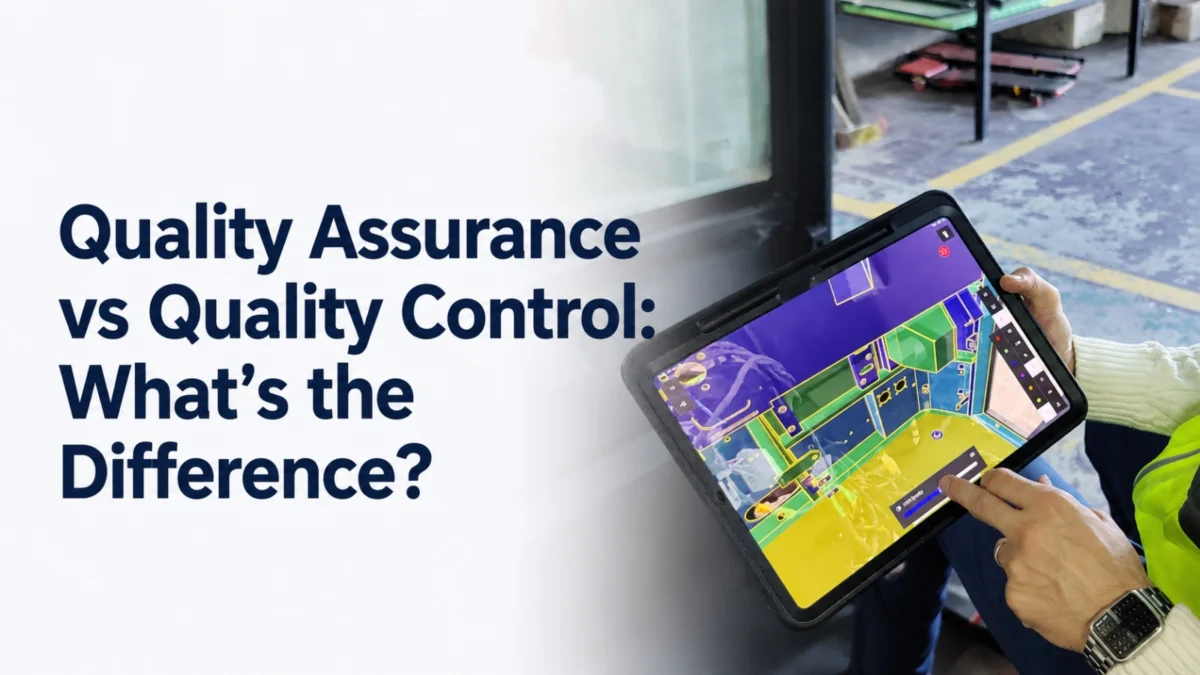
SuPAR App supports structured, AR-guided visual inspection using inspection projects prepared from CAD data, helping quality teams follow defined checkpoints and capture inspection results in a traceable digital record.
How do QA and QC work together?
QA and QC are complementary, not competing functions. A manufacturing operation that invests heavily in QA but ignores QC has no verification mechanism; it assumes the process works without checking the result. An operation focused entirely on QC is in a permanent firefighting loop: finding and rejecting, but never eliminating the root causes.
Effective quality systems integrate both through a closed improvement cycle:
- QA sets the framework. Define what conforming product means. Build processes that produce it consistently. Document the standards and train the people who execute them.
- QC generates the signal. Inspection data shows whether processes are performing as intended. A spike in rejections is not just a product problem, it signals that the QA framework has degraded somewhere.
- CAPA closes the loop. When QC finds defects, root-cause analysis and process correction prevent recurrence, and the QA framework is strengthened.
SuPAR Composer supports this process by allowing quality teams to prepare structured inspection projects from existing CAD data, define checkpoints and visual guidance, and create reusable inspection templates for execution on the shop floor.
Effective QA reduces the number of defects QC needs to detect, while QC remains essential for verifying product conformity.
What tools and technology support QA and QC?
Modern manufacturing quality depends on technology to sustain QA and QC functions at production scale and speed.
For Quality Assurance:
- Document management systems for SOPs, work instructions, and change control
- Statistical process control (SPC) software for real-time process monitoring
- Process FMEA and control plan development tools
- Digital audit management and CAPA tracking platforms
For Quality Control:
- Coordinate measuring machines (CMMs) and contact gauging
- Automated optical inspection (AOI) and machine vision systems
- AR-guided inspection platforms like SuPAR App, which overlay inspection steps, measurement locations, and pass/fail criteria directly onto physical parts
For both functions:
- Quality management systems (QMS) connecting process documentation to inspection records
- AI-powered inspection tools like SuPAR AI that automate selected repetitive inspection tasks, including hole detection, spot weld verification, stud inspection, position checks, and absence detection
How are AR and AI reshaping quality assurance and quality control?
Augmented reality and artificial intelligence are compressing the gap between QA design intent and QC execution, and changing what both functions can achieve.
AR can help standardize QC inspection. AR platforms provide operators with the same step-by-step visual guidance, inspection sequence, and defined criteria, helping reduce interpretation variability between operators and shifts. Every inspector follows the same procedure and evaluates against the same criteria, regardless of experience level or shift.
AI automates selected defect-detection tasks. Deep learning vision systems can apply consistent detection criteria across repeated inspections, making them particularly useful for well-defined and repetitive quality-control tasks such as hole detection, spot weld verification, stud inspection, position checks, and absence detection. Performance depends on factors such as training data, imaging conditions, process variation, and system validation.
AI strengthens QA analytics. Predictive analytics applied to production sensor data, environmental conditions, and historical defect patterns can flag process drift before nonconforming parts are produced, turning QA from a periodic audit function into a continuous monitoring capability.
Frequently Asked Questions
Which comes first, quality assurance or quality control?
Quality assurance comes first. QA defines the processes, standards, and controls designed to produce conforming products. QC then verifies those processes are working by inspecting actual output. In practice both run in parallel throughout the production cycle, but the QA framework must exist before standardized, meaningful QC can take place, without defined standards, inspectors have nothing to measure against.
Can the same team handle both quality assurance and quality control?
In smaller facilities, yes: the same people often perform both functions. In larger operations, QA and QC are typically separated: QA operates at the system and compliance level while QC is embedded on the production floor. The critical requirement is that the functions remain conceptually distinct; QC inspectors apply standards defined by the QA process, not improvised criteria.
What is the cost of poor quality and how do QA and QC reduce it?
The cost of poor quality (COPQ) includes scrap, rework, warranty claims, returns, customer complaints, and reputational damage. Industry benchmarks place COPQ at 5–30% of annual revenue for manufacturing organizations. QA reduces COPQ by preventing defects from being produced, addressing the most expensive quality cost category. QC catches defects before customers receive them, where the cost of failure multiplies by factors of 10 to 1,000 depending on the industry.
How does augmented reality support quality control inspection?
Augmented reality is transforming quality control in manufacturing by making inspection processes more visual, standardized, and traceable. Augmented reality quality control platforms such as SuPAR App overlay inspection steps, measurement locations, and accept/reject criteria directly onto physical parts or assemblies. This AR inspection approach helps operators perform standardized checks without relying on paper documents or switching between the part and a separate screen.
As an advanced quality inspection software solution, SuPAR App also captures inspection results digitally as the process is performed. This supports more consistent manufacturing quality control, improves traceability across inspections, and helps quality teams maintain reliable records for customer requirements and audit processes.
Why is a high QC rejection rate a QA problem, not a QC problem?
A high QC rejection rate means defects are being produced upstream, in the process, before inspection ever sees them. Adding more inspection points does not stop defect production; it only catches more nonconforming parts. Reducing the rejection rate requires root-cause analysis directed at the process factors driving defect occurrence: equipment, materials, methods, environment, or personnel. That is QA territory.