
Transportwesen, Fertigungsprozesse und Qualitätskontrolle mit Augmented Reality
Präzisionsprüfung für Busse, Lkw, Auflieger und Schienenfahrzeuge
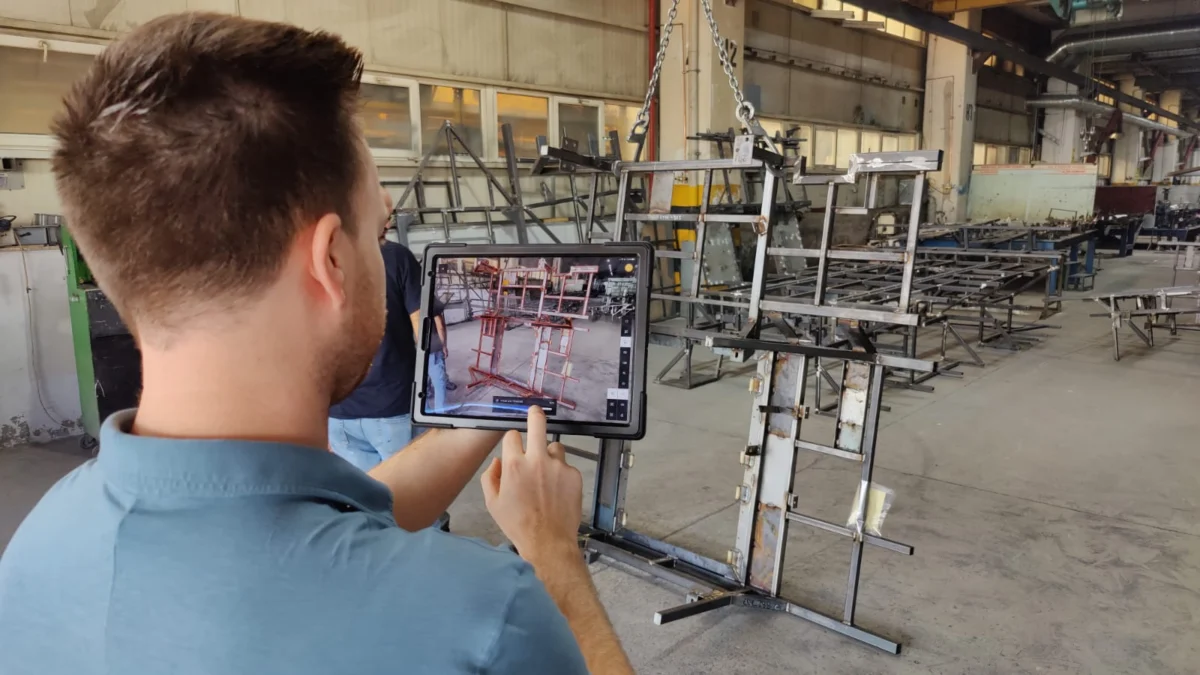
Transportation manufacturing quality inspection is the process of checking vehicle structures, assemblies and supplied parts against their engineering reference before they move to the next production step. In buses, trucks, trailers, rail vehicles and agricultural machinery, it covers welded chassis and frames, body structures, welding and assembly fixtures, large welded assemblies, end-of-line visual checks and incoming supplier parts. The goal is to confirm that the required components are present, sit in the intended position and match the design release, so issues are found early rather than at final assembly.
SuPAR is an augmented reality visual inspection platform for manufacturing, developed by CDMVision. It overlays CAD data, inspection checkpoints and visual guidance onto the physical part, so your quality team compares the digital reference and the real component in the same view. This helps make transportation inspection more structured, visual and traceable.
SuPAR Transportation
SuPAR bringt AR-gestützte Prüfung in die Fertigung von Bussen, Lkw, Aufliegern, Schienenfahrzeugen und Landmaschinen. Von der Prüfung geschweißter Rahmen bis zur Kontrolle des Vorrichtungsaufbaus sorgt die CAD-Überlagerung in Echtzeit für die präzise Prüfung großformatiger Schweißkonstruktionen und bearbeiteter Bauteile.
Hersteller nutzen SuPAR, um Wareneingangsteile von Lieferanten zu prüfen, Schweißkonstruktionen gegen CAD-Daten abzugleichen, die Live-Positionierung von Montageelementen zu unterstützen und Schweißvorrichtungen zu kontrollieren — vollständig ohne Papierzeichnungen. Eine Erfahrungsauswertung bei einem OEM zeigte, dass SuPAR die Prüfung 6-mal schneller macht als klassische Verfahren und den Anteil der Prüfzeit an der Arbeitszeit eines Prüfers von 85 % auf 15 % senkt.
SuPAR unterstützt außerdem die Geometrie- und Montageprüfung tiefgezogener Kunststoffteile für die Bus- und Lkw-Fertigung — inklusive Prüfung nach der Nachbearbeitung und Ausrichtungskontrolle gegenüber Metallhaltern.
What makes transportation manufacturing quality inspection difficult?
Transportation manufacturing quality inspection is difficult because the parts are large, highly variant and often welded by hand in low volumes. A single bus or trailer frame can carry hundreds of brackets, studs, nuts and gussets, and model variants change their layout.
In general, inspectors rely on 2D drawings, printed checklists and experience to confirm these features. On a structure several metres long, it is easy to overlook a missing bracket or a stud welded in the wrong place. Interpretation also differs between inspectors and shifts.
Paper-based findings are hard to trace back to a specific frame. When a problem appears at final assembly, the team often cannot see where it entered the process.
How does SuPAR support transportation manufacturing quality inspection?
SuPAR supports transportation manufacturing quality inspection by placing the nominal CAD model directly over the physical structure on a LiDAR-enabled iPad Pro. The inspector walks around the frame and sees, in one view, where each component should be and whether it is there.
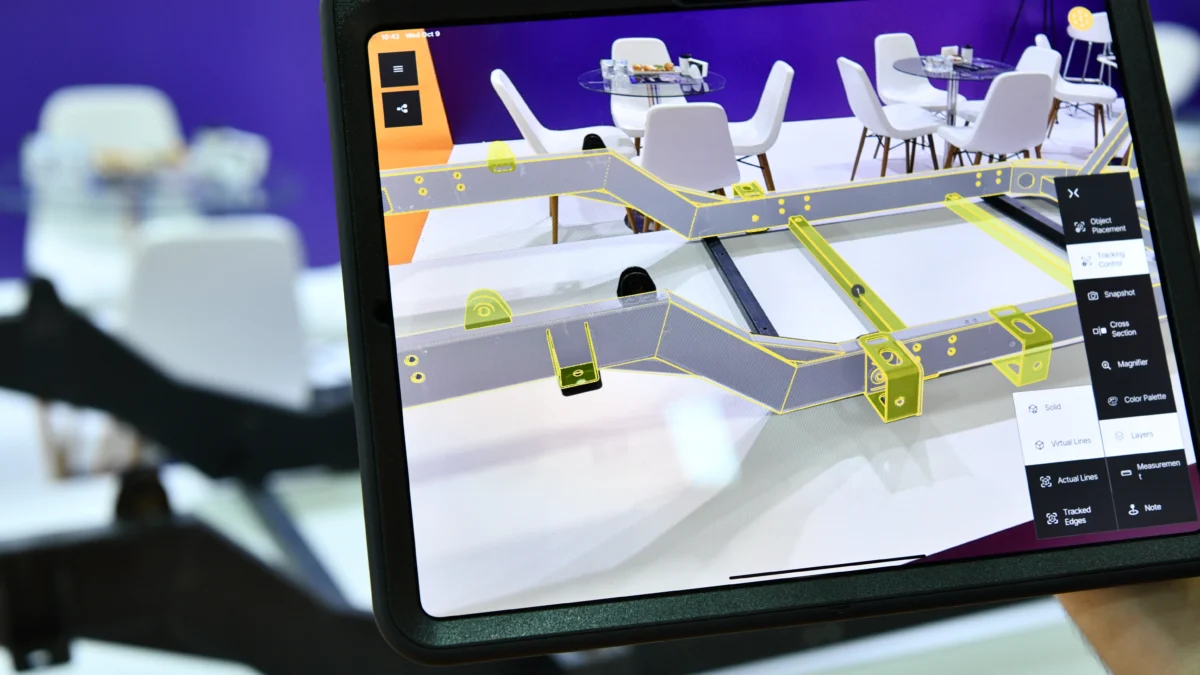
The workflow starts in SuPAR Composer, which imports your existing CAD data from systems such as CATIA, Siemens NX, PTC Creo or SolidWorks, as well as neutral formats such as JT and STEP. Composer generates tracking geometry automatically, and engineers define inspection checkpoints, annotations and reusable inspection templates for each vehicle variant.
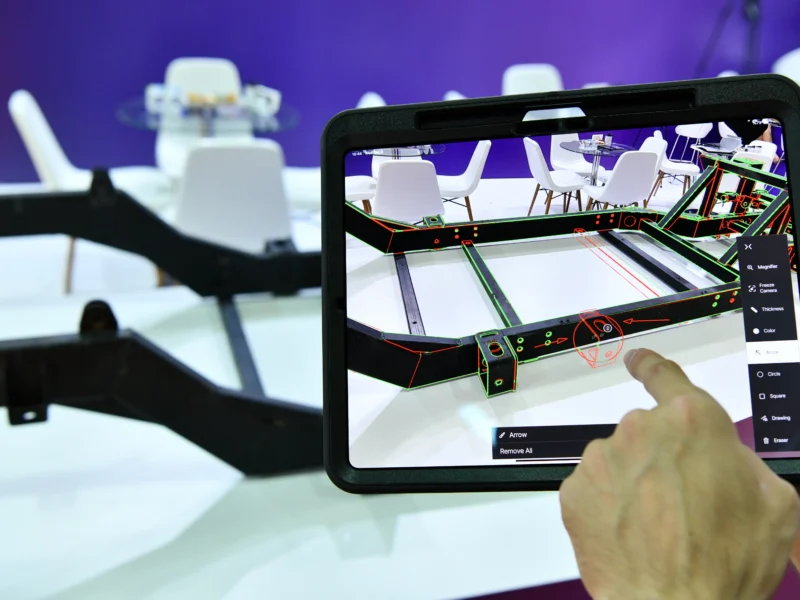
An der Produktionsfläche ist das SuPAR App guides the inspector through those checkpoints. Edge comparison highlights the overlay in green and red, which makes missing, extra or misaligned components visible. Findings are pinned to the 3D model as notes with a photo, comment and symbol, and reports export as PDF, Excel, Word or 3D files.
Which welded structures suit transportation manufacturing quality inspection with AR?
Welded chassis, frames and body structures suit transportation manufacturing quality inspection with AR because their main risks are visual: missing, extra or mispositioned parts. Typical targets include truck and trailer chassis, bus body frames, rail vehicle sub-assemblies and agricultural machine frames.
With SuPAR, an inspector can verify bracket, stud and nut presence, check part positions against the CAD overlay and confirm that welded assemblies are complete. Weld information defined in the CAD model can be shown on the physical part as annotations, which helps the inspector confirm weld seam locations visually.
Für geeignete wiederkehrende Ziele, SuPAR AI adds automated visual verification of spot welds, holes and studs inside the same inspection template. Performance depends on training data, imaging conditions, process variation and validation, so it is applied to selected checks rather than the whole structure.
Thermoformed plastic parts used in bus and truck interiors and exteriors can also be checked visually against CAD, including the position of mounting brackets after machining.
How do fixtures and assembly fit transportation manufacturing quality inspection?
Welding and assembly fixtures fit transportation manufacturing quality inspection because a fixture that is built or changed incorrectly repeats the same error on each frame. Checking the fixture visually is a way to catch the cause, not only the symptom.
In general, fixture checks are done after build, after maintenance and after configuration changes for a new variant. SuPAR overlays the fixture’s virtual model onto the physical fixture, so your team can confirm that locators, clamps and supports sit in their intended positions. The Kontrolle der Befestigungseinrichtung approach follows the same logic.
SuPAR also supports welding assembly with a physical-digital mock-up. Using partial tracking, workers see the next virtual part over the real welded structure, with correct placement and sequence shown step by step. Digital assembly instructions and checklists reduce dependence on paper-based methods, and a Microsoft Teams connection lets a remote engineer view the same 3D hologram.
Where do supplier parts fit in transportation manufacturing quality inspection?
Supplier parts fit in transportation manufacturing quality inspection at incoming inspection, where problems are cheapest to stop. Prototypes, sub-assemblies and welded parts from suppliers can be checked before they reach the line.
With SuPAR, an inspector selects the part, loads its inspection template and verifies completeness and component positions against CAD. Missing elements or visibly wrong geometry are recorded on the 3D model. Reports open in the free, browser-based SuPAR Web Viewer, so suppliers and approvers can review findings without installing software. The same approach supports end-of-line interactive inspection before delivery.
What results do customers report in transportation manufacturing quality inspection?
Transportation customers report productivity gains and broader inspection coverage with SuPAR in quality control. TEMSA, a bus and commercial vehicle manufacturer, reports a 60% productivity increase in quality control, as described in the TEMSA success story. The story also notes efficiency gains in jig and fixture setup.
ZASLAW, a Polish maker of vehicles and commercial bodies, uses SuPAR for trailer chassis inspection, presence and absence verification and bracket position verification, according to the ZASLAW success story. Anadolu Isuzu applies SuPAR across incoming quality control, assembly, internal trim operations, pre-delivery inspection and final assembly quality.
What limits AR in transportation manufacturing quality inspection?
AR in transportation manufacturing quality inspection is limited because SuPAR verifies visual presence, position and absence only. It does not measure parts or evaluate tolerances.
SuPAR complements, and does not replace, dimensional measurement systems such as CMMs, gauges or 3D scanning. Where you already have scan or CT data from external systems such as GOM or CREAFORM, the SuPAR App can display it as a color map on the part, but the data itself is produced by those systems. Results depend on the application and system configuration.
If you want to see how this works on your own chassis, frames or fixtures, Anfrage nach einer Demo and bring a CAD model of a typical part.
Transportation Manufacturing Quality Inspection FAQ
What does transportation manufacturing quality inspection cover?
Transportation manufacturing quality inspection covers welded chassis and frames, body structures, welding and assembly fixtures, large welded assemblies, end-of-line checks and supplier parts for buses, trucks, trailers, rail vehicles and agricultural machinery. SuPAR addresses the visual part of this work: confirming that components are present and correctly positioned against CAD, not dimensional checks.
Can AR transportation manufacturing quality inspection be used on large trailer chassis?
Yes, AR can support transportation manufacturing quality inspection on large trailer and truck chassis. ZASLAW uses SuPAR for trailer chassis inspection and bracket position verification. The inspector moves around the structure with an iPad Pro while the CAD overlay stays registered. Suitability depends on part size, lighting and the tracking setup chosen during evaluation.
Does SuPAR replace CMMs in transportation manufacturing quality inspection?
No, SuPAR does not replace CMMs, gauges or 3D scanning in transportation manufacturing quality inspection. It verifies visual presence, position and absence of components against CAD. Dimensional checks stay with your measurement systems. SuPAR can display externally produced scan or CT data as a color map, but it does not generate that data.
Which CAD formats work for transportation manufacturing quality inspection with SuPAR?
SuPAR Composer imports native CAD from CATIA, PTC Creo, Siemens NX, SolidWorks and Inventor for transportation manufacturing quality inspection. It also reads kernel formats such as Parasolid and ACIS, and neutral formats including JT, STEP, FBX and STL. Further formats are supported, so confirm your specific formats during evaluation.
Can SuPAR AI automate parts of transportation manufacturing quality inspection?
SuPAR AI can add automated visual verification to selected parts of transportation manufacturing quality inspection, such as spot weld, hole and stud checks. It is intended for suitable repetitive targets under defined operating conditions. Performance depends on training data, imaging conditions, process variation and validation, so it complements the AR-guided inspector workflow.
Prüfung von Schweißkonstruktionen und bearbeiteten Teilen
Schnelle und einfache Prüfung von Schweißkonstruktionen wie Lkw-Rahmen, Busgerippen und Landmaschinen. Verifizieren Sie die Position geschweißter Bauteile zügig und erkennen Sie fehlende Elemente wie Halter, Bolzen oder Muttern.
Freigabe von Wareneingangsteilen
Deutlich schnellere Wareneingangsprüfung durch sofortige visuelle Kontrolle per AR. Wählen Sie Bauteile über Name, QR-Code oder Barcode aus und führen Sie Vorabprüfungen der Geometrie an Prototypen oder Unterbaugruppen durch — für die frühzeitige Erkennung von Qualitätsproblemen.
- Fehlende Elemente und falsche Geometrien schnell finden
- Höhere Prozesssicherheit als bei klassischen Verfahren
- Fernfreigabe beim Lieferanten per AR
- Digitaler Bericht unmittelbar nach der Prüfung (Quality 4.0)
Live-Positionierungshilfe bei der Schweißmontage
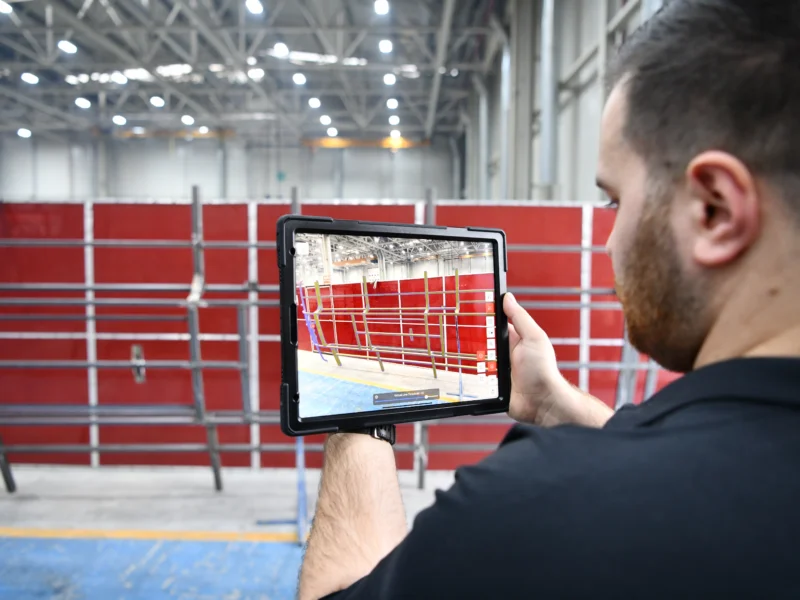
Das physisch-digitale Mock-up blendet virtuelle CAD-Modelle auf reale Schweißkonstruktionen ein, damit Werker die nächsten Montageschritte erkennen. Digitale Montageanweisungen sorgen für einen schnelleren, sichereren und präziseren Fertigungsprozess.
- Virtuelle Bauteildarstellung auf Schweißkonstruktionen
- Nächstes zu montierendes Bauteil per CAD-Überlagerung erkennen
- Digitale Montageanweisungen
- Sicherer Montageprozess
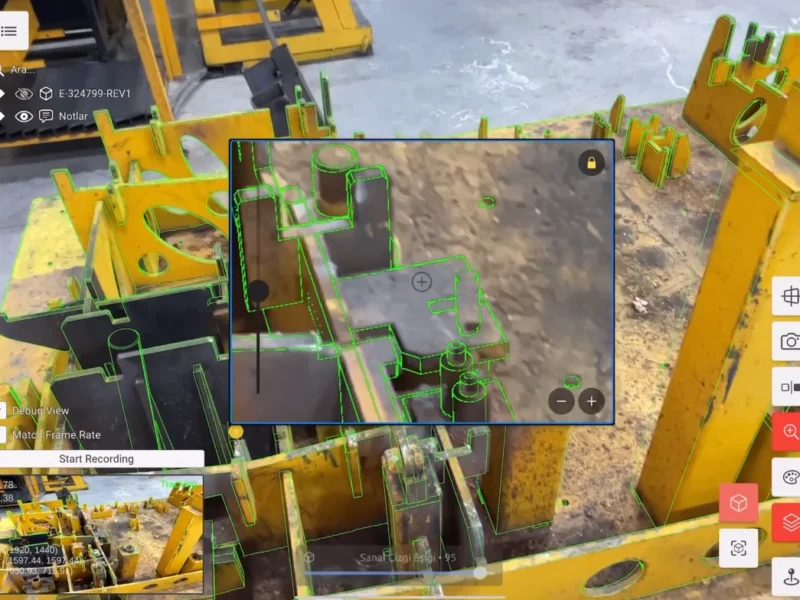
Prüfung und Instandhaltung von Vorrichtungen
Verbesserte Qualitätskontrolle für Schweiß- und Prüfvorrichtungen mit Führung und Rückmeldung in Echtzeit. Das reduziert Fehler und Stillstandszeiten und erleichtert Fernunterstützung, Schulung und Instandhaltung.
- Sicherstellen, dass die Vorrichtung vollständig aufgebaut ist
- Visuelle Bewertung der Ausrichtung zwischen virtuellem Modell und Vorrichtung
- AR-unterstützte Umrüstung von Vorrichtungen
- Fernunterstützung und Schulung möglich
Funktionen
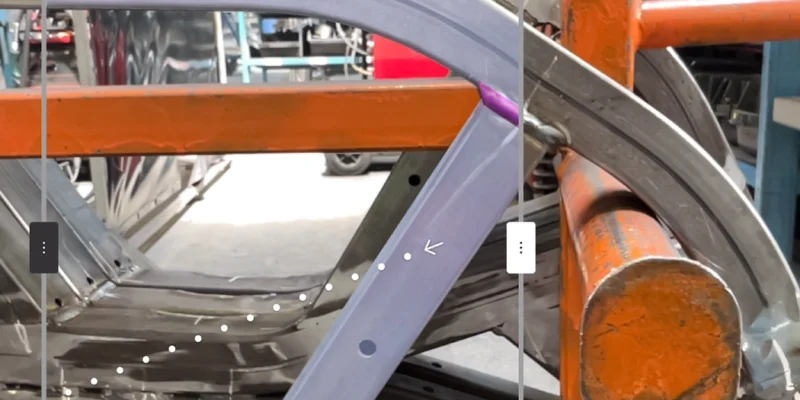
Schweißaufsicht
Vizualisieren Sie PMI-Daten direkt auf dem physischen Teil, um Schweißnähte effizient zu überprüfen – auch wenn Schweißinformationen im CAD-Modell fehlen. Überprüfen Sie das Vorhandensein und Fehlen von Schweißnähten mit klaren Anmerkungen, die auf realen Komponenten überlagert sind.
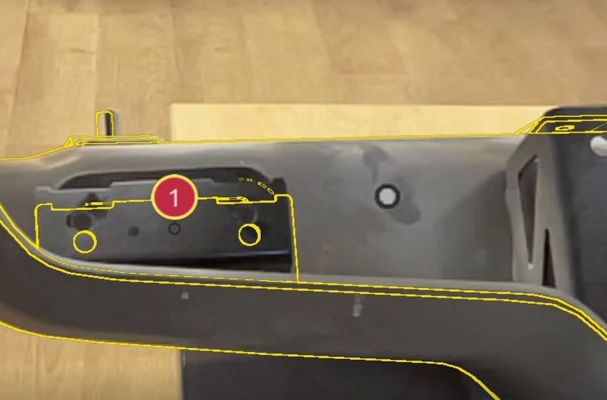
Kunststoffteile Geometrie- und Montageprüfung
Geometrie- und Montageprüfung für thermoplastische Kunststoffteile im Bus- und LKW-Bau. Unterstützt Nachbearbeitungskontrollen und Ausrichtungsprüfungen mit Metallwinkeln.